
Calgary's Hard Water: Effects on Your Plumbing and What to Do
What hard water does to fixtures and water heaters over time, and whether a softener is worth it.
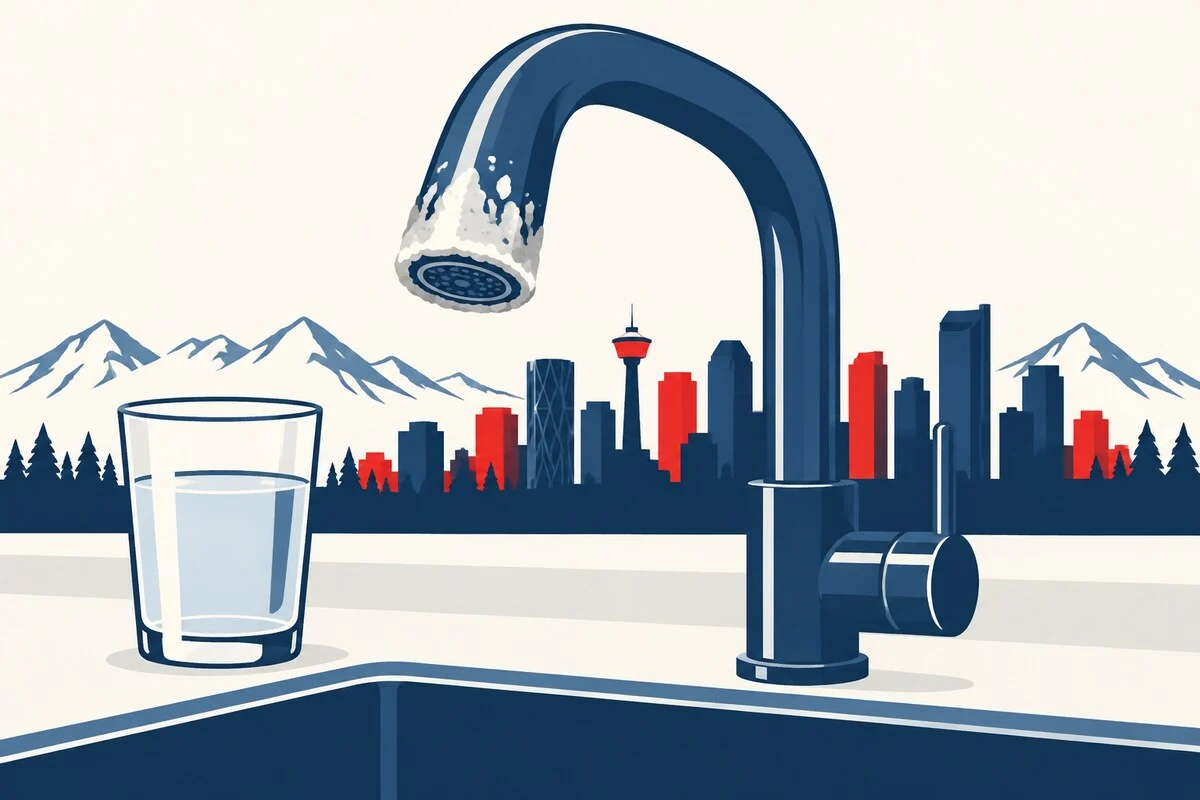
Short answer: Yes, Calgary's water is hard. City data puts it at roughly 141 to 274 mg/L, or about 8 to 16 grains per gallon. It is safe to drink, but over the years the minerals leave scale that shortens water heater life, clogs fixtures and spots glass. A water softener is worth it for many Calgary homes, especially when you are replacing a water heater.
Hard water is not a health problem. It is a maintenance and equipment problem, and it shows up slowly enough that most people only notice it when something fails.
How hard is Calgary's water?
The City publishes the numbers. Its water quality page lists hardness of 141 to 274 mg/L, which comes from natural minerals in the river water. It varies with the season and with which treatment plant supplies your area.
| Source | 2025 average hardness | About |
|---|---|---|
| Bearspaw plant (Bow River) | 174 mg/L | 10 grains per gallon |
| Glenmore plant (Elbow River) | 224 mg/L | 13 grains per gallon |
Water treatment companies generally call anything above 7 grains per gallon hard. Water softeners are usually set in grains per gallon, so that is the number to give whoever installs one. To convert, divide mg/L by 17.1.

What does hard water do to your plumbing?
| Where | What happens |
|---|---|
| Water heaters | Scale and sediment build up on the bottom, making the burner or elements work harder and shortening the tank's life |
| Tankless water heaters | Scale inside the heat exchanger. Needs regular descaling |
| Faucets, aerators and showerheads | White crust and slow flow |
| Dishwashers and washers | Scale on elements and valves, spots on dishes and glass |
| Furnace humidifiers | Scaled pads and steam canisters that stop working |
| Soap and detergent | Lather less and leave film behind |
Is a water softener worth it?
For many Calgary homes, yes, especially if you are already replacing a water heater or you see constant scale. A softener protects the water heater, fixtures and appliances downstream of it and is usually a straightforward install. It makes the most sense when:
- you are installing a new water heater, especially a tankless one;
- you are renovating a kitchen or bathroom with new fixtures;
- you are cleaning scale off faucets and glass every week.
We can tell you whether it makes sense for your home rather than selling one by default.
What can you do without a softener?
- Flush the water heater to clear sediment.
- Soak aerators and showerheads in vinegar to dissolve scale.
- Use a rinse aid in the dishwasher.
- Replace the furnace humidifier pad every fall.
Common questions
Is Calgary tap water safe to drink?
Yes. Hardness is about minerals like calcium and magnesium, not safety. The City publishes its water quality results.
Does a water softener make water salty?
Softened water contains a small amount of sodium from the softening process. Some people keep one unsoftened tap for drinking. If sodium is a concern for you, ask your doctor.
Can hard water cause a rotten egg smell?
Not on its own, but adding a softener can speed up the reaction with a water heater's anode rod that causes the smell. It is a fixable side effect.
Related guides
Ready when you are.
Tell us what is going on and the Northern Flame team will get back to you within one business day.
Get a Free Quote