
What Is a Backwater Valve and Does Your Calgary Home Need One?
How it protects a finished basement from a sewer backup, and which homes should have one.

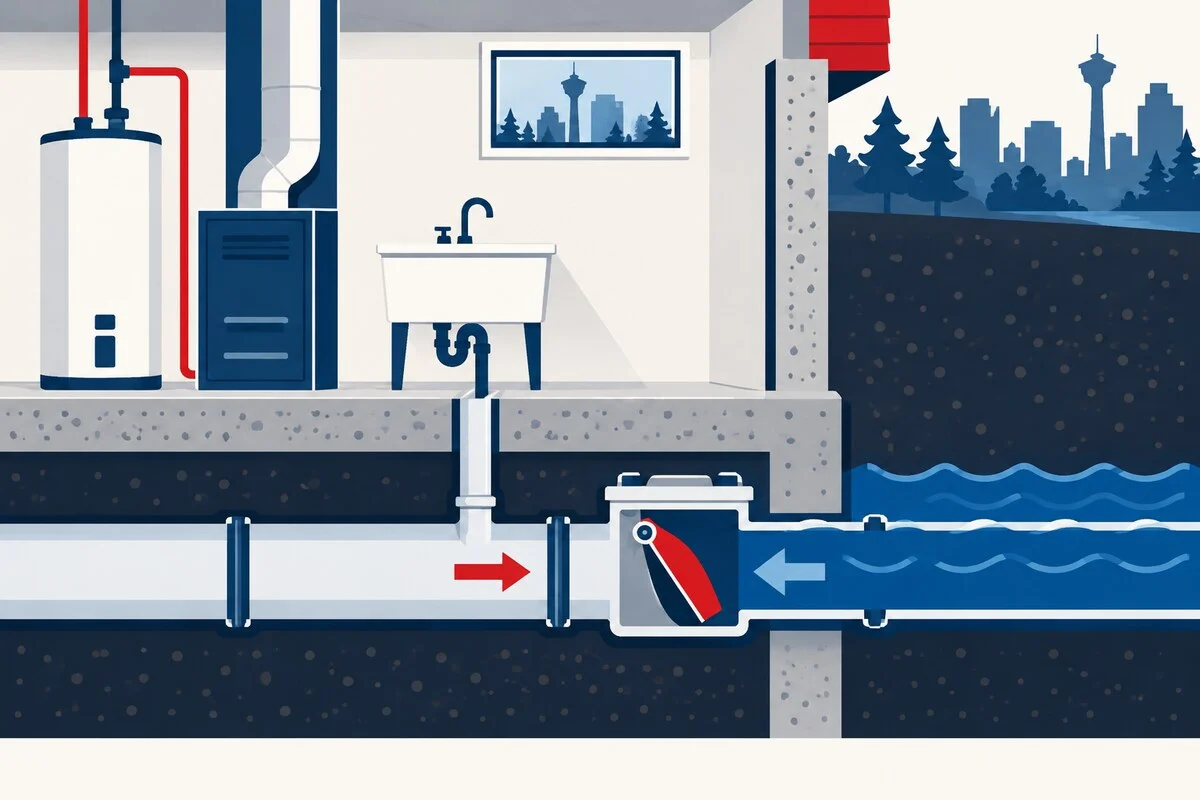
Short answer: A backwater valve is a one-way gate on your main sewer line. Waste flows out normally, but if the city sewer surges during a heavy storm, a flap closes and keeps sewage from backing up into your basement. If you have a finished basement, especially in an older home, it is one of the cheapest protections against a very expensive mess.
Sewer backups do not care how nice the basement is. A valve that costs far less than one cleanup is worth checking for, and worth installing if it is missing.

How does a backwater valve work?
It sits on the main drain where it leaves the house, usually under an access cover in the basement floor. Under normal flow, water and waste pass straight out. If the city line surges and pushes back, a flap closes and holds it out of your home until the surge passes. A clear cover lets you see inside and clean it.
Backwater valve or sump pump?
| Backwater valve | Sump pump | |
|---|---|---|
| Protects against | Sewage backing up from the city sewer | Groundwater rising around the foundation |
| Where it is | On the main sewer line, in the basement floor | In a pit in the basement, fed by weeping tile |
| Needs power | No | Yes, unless it has a battery backup |
| Maintenance | Inspect and clean the flap periodically | Test before spring melt and storm season |
Many Calgary basements need both. They solve different problems.
Which homes should have one?
- Older Calgary homes, many of which were built without one.
- Any home with a finished basement, where a backup means drywall, flooring and belongings.
- Homes that have had a backup before, or that are in a low spot on the street.
- Homes with a basement suite. The City of Calgary has a plumbing advisory on backwater valves for secondary suites, because a valve serving more than one unit may need to be set up differently.
Newer Alberta homes are commonly built with one. If you are not sure whether yours has one, look for a round or rectangular access cover in the basement floor near where the main drain leaves the house.
What does installing one involve?
- Confirm where the main drain leaves the house and how deep it is.
- Cut and remove a section of the concrete floor over the line.
- Install the valve with an access box so it can be cleaned.
- Permit and inspection. In Calgary, altering a plumbing system needs a permit.
- Patch the concrete.
It is worth asking whether any City program currently applies before you book. Programs change, so check calgary.ca or ask us.
Keeping it working
- Open the cover and check the flap moves freely a couple of times a year.
- Clear any debris around the flap.
- Do not store boxes or build over the access cover.
- During a backup event, limit water use in the house. With the valve closed, water you run inside has nowhere to go.
Common questions
Does my Calgary home have a backwater valve?
Look for an access cover in the basement floor near where the main drain leaves the house. Many newer homes have one. Many older homes do not.
Can a backwater valve cause problems?
Only if it is not maintained. A flap jammed with debris can slow drainage. A quick check a couple of times a year prevents it.
Will a backwater valve stop all basement flooding?
No. It stops sewer backups. Groundwater coming in through the foundation is a sump pump and grading problem.
Related guides
Ready when you are.
Tell us what is going on and the Northern Flame team will get back to you within one business day.
Get a Free Quote